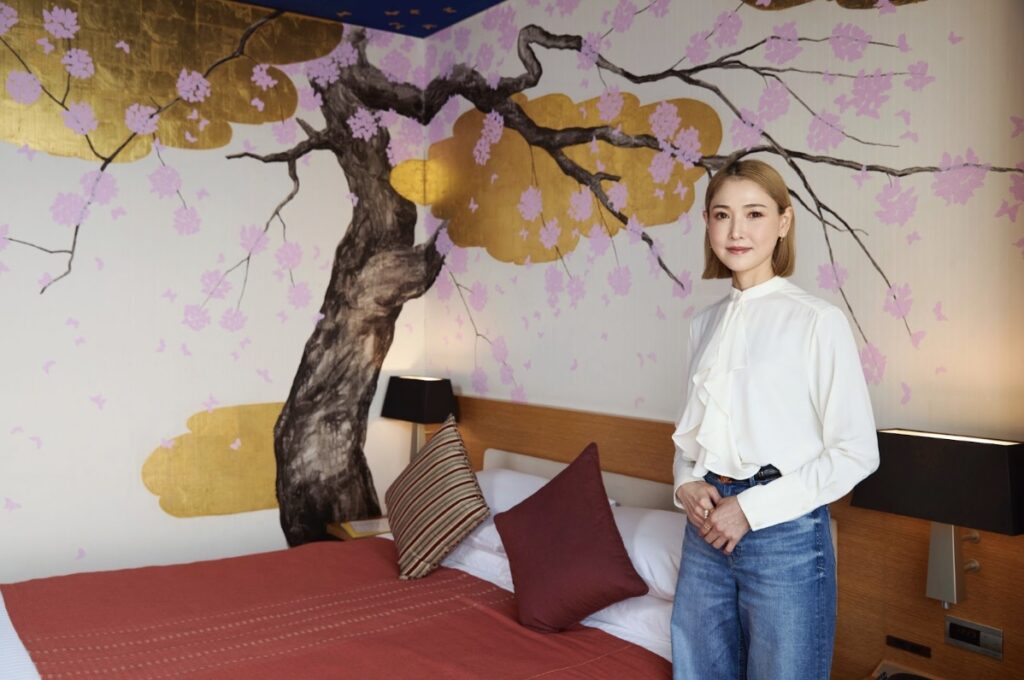
Exploring the ideas behind the Sakura room, where time, dreams, and the changing seasons intersect.

The Artist Room Sakura at Park Hotel Tokyo (operated by Shiba Park Hotel Co., Ltd., headquartered in Minato City, Tokyo; President and CEO: Rentaro Yanase) is a one-of-a-kind guest room in which the entire space becomes a work of art, completed after a one-month artist residency by contemporary Nihonga painter Hiroko Otake. In this interview, Otake discusses the story behind the creation, the themes of the work, and the thoughts embedded in the room.
Interview with Contemporary Nihonga Painter Hiroko Otake
Q1. Unlike creating paintings on a flat surface, painting an entire hotel room as a single artwork must have been a major challenge. Could you describe any ideas or difficulties encountered while, aware of the surrounding space, you painted the room itself?
In Nihonga, there is a tradition called shoheiga that developed from the Momoyama period to the early Edo period. Artworks were painted on large-scale architectural elements such as fusuma sliding doors and folding screens, and were designed as part of an entire ambience, with Nijo Castle being a well-known example.
I have not had the opportunity to paint in shoheiga-scale before, so when 10 years ago I was in charge of producing an Artist Room, I painted with all my might across the corners of the walls and even the ceiling. For me this experience was a valuable opportunity where I could reinterpret traditional shoheiga with a contemporary sensibility.
There were also technical challenges. Nihonga is normally crafted with mineral pigments. Because these pigments are heavy, it is usually painted on a flat horizontal canvas, gathering the pigments on the surface, and allowed to dry completely before being placed upright. However, the verticality of the walls in this project would make the pigments run downwards, so I chose to work with acrylic gouache instead.
For the painting of the cherry blossoms, I was strongly influenced by “Sakura Zu” by Kyuzo- son of Tohaku Hasegawa. Simply painting cherry blossoms in a modern style was not interesting enough, so I represented every petal as a butterfly. At first glance they appear to be cherry blossom petals, but upon closer inspection they reveal the shape of butterflies. My intention was that guests staying in the room would enjoy discovering this trick during their stay.
Q2. Butterflies can be used as a motif symbolizing beauty and truth within transience. What was the reason behind choosing butterflies for this artwork?
I was very inspired by “Butterfly Dream”, by Chinese philosopher Zhuang Zhou. In this story, the philosopher dreams that he becomes a butterfly, and after waking up cannot determine whether he is himself who dreamed of being a butterfly, or a butterfly dreaming it is Zhuang Zhou. It is a fantastical narrative in which the boundary between dream and reality becomes unclear.
Whether in dreams or in reality, the self remains the same. I see the world not as a single, fixed reality, but as something where two different perspectives can exist at the same time. This idea is closely connected to my own artistic concept. In this Artist Room as well, I explored the theme of duality—dream and reality, and a world where different timelines coexist.
In a museum, people rarely look up at the ceiling, but in a hotel room, when lying in bed, the ceiling naturally comes into view. At that moment, I hope the butterflies painted there feel as though they are fluttering inside a dream. The lower part of the room represents the world of reality, while the ceiling represents the world of dreams, expressing the image of two worlds existing simultaneously.
I hope guests feel as though the butterflies are gently inviting them into a dreamlike world when they look up at the ceiling.
Q3. The work expresses two different timelines: the fleeting nature of falling cherry blossoms and the seasonal cycle of Spring, Summer, Autumn, and Winter depicted throughout the room. Was this portrayal of time something you consciously intended?
Yes, and I’m very happy that it came across that way. The momentary beauty of cherry blossoms and the endless cycle of the seasons—two opposing senses of time—exist together within the same space. That coexistence is really at the heart of the room’s worldview and concept.
The beauty of things that are ephemeral, and the quiet strength of things that continue unchanged. I wanted to explore how that contrast could be expressed within a single room, and that became an important guiding idea throughout the creation process.
Q4. You have created this work over a one-month stay at Park Hotel Tokyo. Could you share any discoveries or memorable moments that came from the process of painting while staying at the hotel?
I was truly grateful to have an environment where I could focus entirely on the work every day. From the room where I stayed, I could see both Tokyo Tower and Mount Fuji, and the sky at dusk changed moment by moment—it was incredibly beautiful.
The passage of time is one of the central themes of this work, so being able to witness those subtle changes in the sky while I was painting was a very special experience. When the work was finally completed, we even had a small celebration with people who had been working nearby, which made it very memorable.
Q5. Finally, could you share a message for guests who will stay in the Artist Room Sakura?
This Artist Room is a space that portrays the passage of time and the changing of the seasons, with the motif of cherry blossoms as a starting point. The butterflies symbolize transformation and renewal, an idea that spreads throughout the entire room.
I hope that the time spent here resonates with each guest’s own memories and senses, allowing them to experience a quiet and deeply enriching moment.
Artist Room Sakura—a dreamlike space of cherry blossoms and butterflies created by contemporary Nihonga painter Hiroko Otake.
Hiroko Otake speaking with a smile about the challenges encountered during the creation process.

Contemporary Nihonga painter Hiroko Otake, creator of the Artist Room Sakura at Park Hotel Tokyo.
